

Solemnity of Mary, Mother of God
- Date
- Day
- Thursday
- Substitute day
- No
WhatNextHoliday.com
Public holidays in Vatican City in 2026
Compatible with Apple Calendar, Google Calendar, Outlook, and mobile devices.
| All public holidays | Date | Day | Substitute day |
|---|---|---|---|
| Solemnity of Mary, Mother of God | Thursday | No | |
| Epiphany | Tuesday | No | |
| Anniversary of the foundation of Vatican City | Wednesday | No | |
| Saint Joseph | Thursday | No | |
| Maundy Thursday | Thursday | No | |
| Good Friday | Friday | No | |
| Easter Saturday | Saturday | No | |
| Easter Sunday | Sunday | No | |
| Easter Monday | Monday | No | |
| In Albis Tuesday | Tuesday | No | |
| Saint Joseph the Worker | Friday | No | |
| Anniversary of the election of Pope Leo XIV | Friday | No | |
| Ascension Day | Thursday | No | |
| Pentecost | Sunday | No | |
| Corpus Christi | Thursday | No | |
| Saints Peter and Paul | Monday | No | |
| Summer holiday | Friday | No | |
| Assumption | Saturday | No | |
| Summer holiday | Sunday | No | |
| Saint Robert Bellarmine - Name day of the Holy Father | Thursday | No | |
| All Saints' Day | Sunday | No | |
| All Souls' Day | Monday | No | |
| Immaculate Conception | Tuesday | No | |
| Christmas Day | Friday | No | |
| Boxing Day | Saturday | No | |
| St. John | Sunday | No | |
| New Year's Eve | Thursday | No |
Maximize your time off in 2026 by taking strategic leave days around public holidays to create long weekends and extended breaks.
Jan 1 - Jan 4
Feb 7 - Feb 11
Mar 19 - Mar 22
Mar 28 - Apr 7
Apr 2 - Apr 7
May 1 - May 3
May 8 - May 10
May 14 - May 17
Jun 4 - Jun 7
Jun 27 - Jun 29
Jun 27 - Jul 5
Aug 8 - Aug 16
Aug 14 - Aug 16
Sep 17 - Sep 20
Oct 31 - Nov 2
Oct 31 - Nov 8
Dec 5 - Dec 8
Dec 25 - Dec 27
Dec 31 - Jan 3
Calculate exact business days and working hours between two dates, excluding weekends and official public holidays.
Vatican City's calendar is shaped by the Catholic liturgical year, the history of the sovereign state and the pontificate of the reigning pope. This makes practical holiday planning different from simply copying Italy's public-holiday calendar. The Vatican Museums publish their own annual opening and closure schedule, while papal liturgies follow a separate calendar issued by the Holy See. [1][2] Visitors should therefore check the specific institution or event they intend to attend rather than assume that every Vatican service follows one universal holiday timetable.
Vatican City is a sovereign state whose institutional history is closely connected with the Lateran Pacts. Vatican sources describe the creation of the state as providing a territorial guarantee for the independence of the Holy See and its mission. [3] The anniversary of the state's foundation consequently has a significance that is specific to Vatican City rather than being an Italian national holiday.
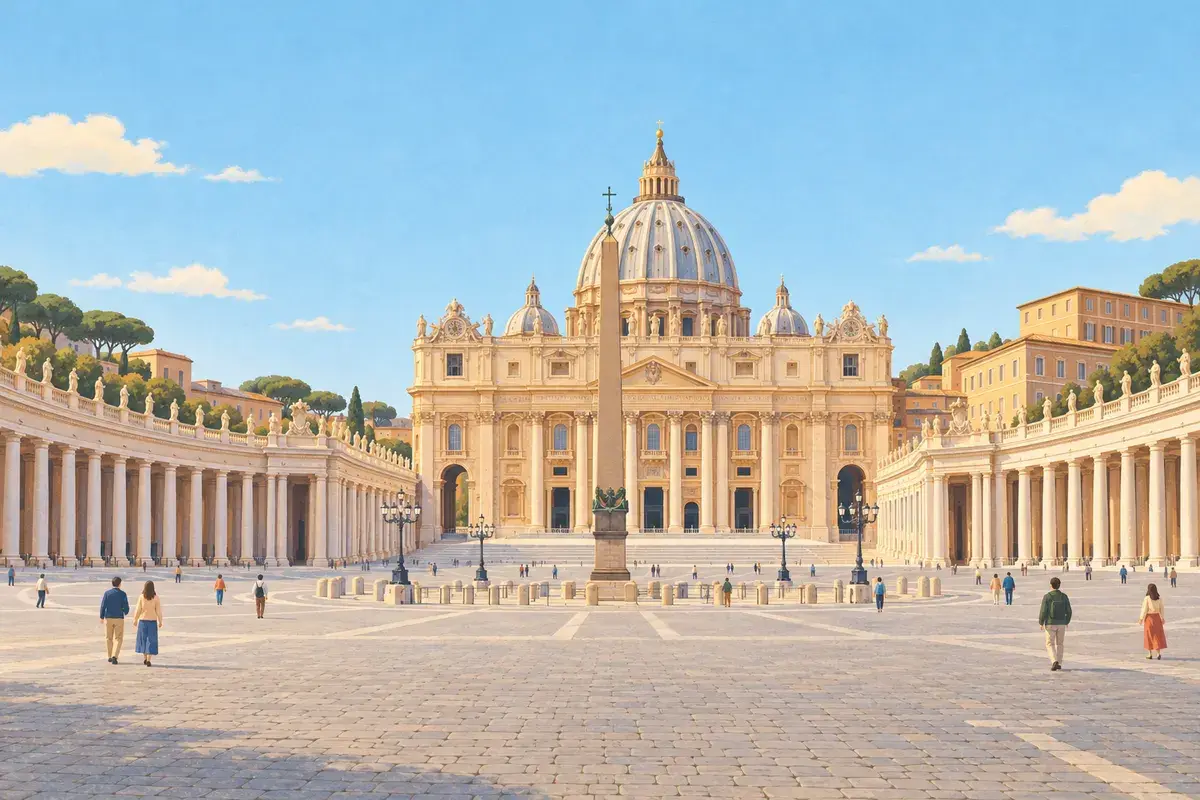
The religious calendar is central to life in and around Vatican City. Major celebrations include Easter, Christmas, Epiphany, the Immaculate Conception and the Solemnity of Saints Peter and Paul. Official papal calendars show that important liturgies may take place in Saint Peter's Basilica, Saint Peter's Square or other papal basilicas, depending on the celebration. [2][4]
Easter is particularly important for visitors. The official Holy Week programme can include papal liturgies in Saint Peter's Basilica and Saint Peter's Square, followed by the Urbi et Orbi blessing from the central loggia of the basilica. [5] Christmas likewise includes major papal celebrations and can draw more people than the basilica itself can accommodate, with Vatican authorities making provision for additional faithful in Saint Peter's Square. [6]
The Solemnity of Saints Peter and Paul has particular significance at the Vatican because the apostles are closely connected with the Church of Rome. Pope Leo XIV has described them as the patrons of Rome and emphasized the feast's connection with the communion between the Church in Rome and churches throughout the world. [7]
Official papal calendars regularly include a solemn Mass for Saints Peter and Paul at Saint Peter's Basilica. [4] The day also appears among the Vatican Museums' closure days, illustrating why visitors should distinguish between a religious celebration that attracts pilgrims and the availability of museums or other Vatican services on the same day. [1]
The Vatican Museums do not simply close on every important Catholic feast or open whenever Saint Peter's Basilica is accessible. They publish a dedicated annual calendar identifying normal opening days, Sundays, holiday closures and any extraordinary changes. [1] The standard schedule generally provides opening from Monday through Saturday and limited opening on the final Sunday of a month, subject to exceptions when that Sunday coincides with specified religious observances.
The published closure calendar includes religious solemnities and Vatican-specific occasions. [1] Because the precise Gregorian dates of moveable feasts change and the Museums issue a fresh schedule for each calendar year, visitors should use the current official Museums calendar rather than reuse dates from an earlier trip.
For a visitor, the largest practical disruption may come from a major papal celebration rather than from the legal classification of a day as a holiday. Official calendars show large liturgies in Saint Peter's Square and the basilica for major solemnities. [2][5] Such events can concentrate large numbers of worshippers and visitors around the Vatican.
Anyone planning a museum visit, basilica visit or attendance at a papal liturgy should therefore consult both the Vatican Museums schedule and the current calendar of celebrations presided over by the pope. [1][2] A museum closure, a basilica liturgy and access to Saint Peter's Square are separate operational questions and should not be inferred from one another.
Vatican City and Italy are separate sovereign entities, despite Vatican City being entirely surrounded by Rome. The Vatican's calendar includes occasions tied specifically to the state and to the papacy, while its religious and institutional schedules are issued by Vatican authorities. The foundation of Vatican City itself is linked to the Lateran settlement that established the state's sovereign status. [3]
No. Vatican City is a separate sovereign state, and its calendar includes occasions connected specifically with the state, the Catholic liturgical calendar and the reigning pontificate. [3] Visitors should check Vatican schedules separately from Italian public-holiday information.
They close on a defined selection of religious and Vatican occasions rather than according to a simple rule covering every feast. The Vatican Museums publish an annual calendar listing closure days and exceptions to their normal opening schedule. [1]